


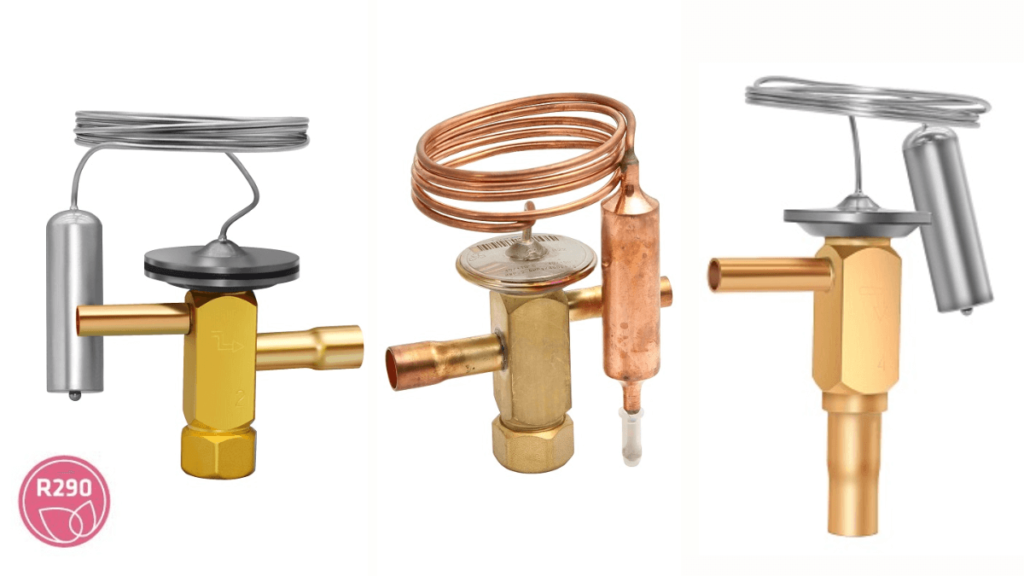
Sanhua, a leading manufacturer of industrial refrigeration and air conditioning components, has introduced the RFGB06 series of thermostatic expansion valves (TEVs) designed specifically for use with propane (R290) refrigerant.
R290, also known as propane, is an environmentally friendly refrigerant with a low Global Warming Potential (GWP) of 3. This makes it an attractive alternative to traditional refrigerants like R404A and R410A, which have high GWPs and are being phased out due to environmental regulations.
Table of Contents
The RFGB06 TEV series is specifically designed to offer several advantages for R290 systems:
- Compact design with built-in orifice: This simplifies installation and reduces the risk of leaks.
- Optional MOP function: This provides additional protection against overpressure.
- Available in straight and angle shapes: This provides greater flexibility for installation in different system configurations.
- Adjustable superheat on-site or factory-set: This allows for precise control of the system’s performance.
- ODF solder connections: These are compatible with a variety of piping materials.
- Equalization port: This is available as an option for systems with long refrigerant lines.
The RFGB06 TEV series is suitable for a wide range of applications, including:
- Commercial refrigeration: This includes applications such as cold rooms, freezers, and ice machines.
- Air conditioning: This includes applications such as split systems and packaged units.
- Dehumidification: This includes applications such as swimming pools and indoor ice rinks.
Sanhua’s introduction of the RFGB06 TEV series is a significant development for the R290 market. This new product line will make it easier for manufacturers and contractors to design and install R290 systems, and it will help to accelerate the adoption of this environmentally friendly refrigerant.
Key features of the RFGB06 TEV series:
- Designed specifically for R290 refrigerant
- Compact design with built-in orifice
- Optional MOP function
- Available in straight and angle shapes
- Adjustable superheat on-site or factory-set
- ODF solder connections
- Equalization port (optional)
Benefits of using the RFGB06 TEV series:
- Improved system efficiency
- Reduced energy consumption
- Lower operating costs
- Reduced environmental impact
- Easier installation
- Reduced risk of leaks
Sanhua is committed to providing its customers with the highest quality products and services. The RFGB06 TEV series is a testament to this commitment, and it is sure to be a popular choice for R290 systems.
FAQ:
- What is an R290 system?
Answer: An R290 system is a refrigeration or air conditioning system that uses propane (R290) as its refrigerant. - What is propane (R290) refrigerant?
Answer: Propane (R290) is a natural hydrocarbon gas that is also often used for heating and cooking. It has a low Global Warming Potential (GWP) and is considered an environmentally friendly refrigerant. - What are the advantages of using R290 refrigerant?
Answer: R290 has several advantages over traditional refrigerants, including
Low GWP: This means that R290 has a minimal impact on the environment.
High efficiency: R290 systems can be more energy-efficient than traditional systems.
Lower operating costs: R290 is a relatively inexpensive refrigerant.
Readily available: Propane is a widely available fuel source. - What are the disadvantages of using R290 refrigerant?
Answer: R290 has some disadvantages compared to traditional refrigerants, including:
Flammable: Propane is a flammable gas, so special precautions need to be taken when handling and installing R290 systems.
Limited availability in some areas: R290 may not be available in all areas, and it may be more expensive than traditional refrigerants in some cases.
Safety regulations: R290 systems are subject to stricter safety regulations than traditional systems. - What are some common applications for R290 systems?
Answer: R290 systems are commonly used in:
Residential and commercial refrigeration: This includes refrigerators, freezers, ice machines, and cold rooms.
Air conditioning: This includes split systems, packaged units, and chillers.
Heat pumps: R290 can be used in heat pumps for both heating and cooling. - How do R290 systems compare to other types of refrigerant systems?
Answer: R290 systems are generally more efficient and environmentally friendly than traditional systems. However, they are also more flammable and subject to stricter safety regulations. - What are the design considerations for R290 systems?
Answer: R290 systems need to be designed with safety in mind. This includes using leak-proof components and installing explosion-proof ventilation systems. - What are the safety requirements for R290 systems?
Answer: The safety requirements for R290 systems vary depending on the jurisdiction. However, they typically include: * Using qualified technicians for installation and maintenance * Providing adequate ventilation * Installing leak detection systems * Having safety equipment on hand - What are the different types of R290 compressors available?
Answer: There are several different types of R290 compressors available, including reciprocating, scroll, and screw compressors. - What are the different types of R290 heat exchangers available?
Answer: There are many different types of R290 heat exchangers available, including plate and frame, shell and tube, and air-cooled condensers. - How do you charge an R290 system?
Answer: Charging an R290 system should only be done by a trained and qualified technician. - How do you maintain an R290 system?
Answer: R290 systems should be regularly inspected and maintained by a qualified technician.
- What is the environmental impact of R290 refrigerant?
Answer: R290 has a low GWP, which means that it has a minimal impact on the environment. This is in contrast to traditional refrigerants, which have high GWPs and contribute to climate change. - How does R290 compare to other refrigerants in terms of Global Warming Potential (GWP)?
Answer: R290 has a GWP of 3, which is significantly lower than the GWP of most traditional refrigerants. For example, R404A, a common refrigerant, has a GWP of 3922. - How does R290 compare to other refrigerants in terms of Ozone Depletion Potential (ODP)?
Answer: R290 has an ODP of 0, which means that it does not contribute to the depletion of the ozone layer. This is in contrast to some traditional refrigerants, such as R12 and R11, which have high ODPs. - Is R290 a flammable refrigerant? Answer:
Yes, R290 is a flammable gas. However, the risk of fire is low if proper safety precautions are taken. - What are the safety precautions for handling R290 refrigerant?
Answer: Some safety precautions for handling R290 refrigerant include:
Working in a well-ventilated area
Avoiding open flames and sparks
Not smoking near R290 equipment
Having fire-fighting equipment readily available
Honeywell Offers Free A2L Refrigerant Safety Training Course


