


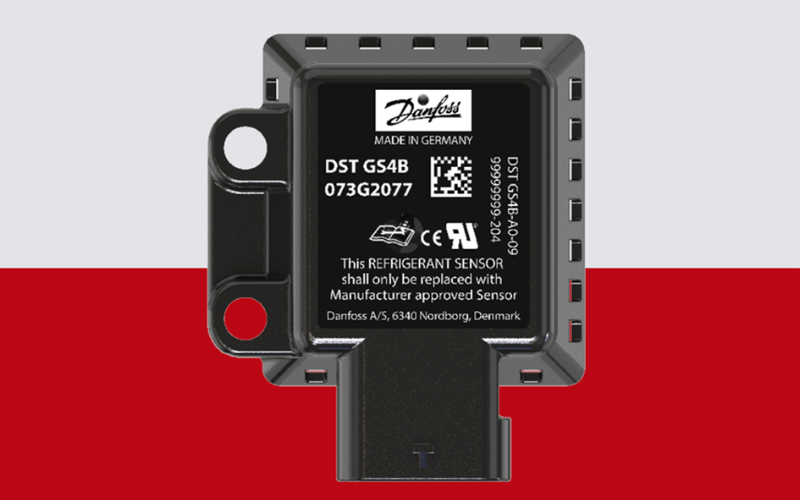
Patented top-down architecture provides extreme environmental protection while supporting five A2L refrigerants in slim, space-saving package
Danfoss Sensing Solutions today announced the launch of the DST GS-series compact gas sensors, featuring the company’s patented top-down inverted design in a slim, compact configuration with IP66 enclosure and IP69K connector ratings, delivering unprecedented protection for A2L refrigerant detection in extreme HVAC/R operating conditions.
The new DST GS gas sensors are designed to meet the market’s need for a compact solution that can withstand harsh environments while providing reliable detection of low-GWP A2L refrigerants that are rapidly becoming the industry standard as HFC phasedown regulations accelerate globally.
The sensor’s enclosure has an IP66 rating, and the connector has an IP69K rating—the highest on the Ingress Protection scale—ensuring reliable operation in environments with dust, water spray, high-pressure washdown, and extreme temperature conditions that would compromise conventional gas sensor technologies.
Table of Contents
Revolutionary Inverted Design: Protection Through Innovation
The GS-series features Danfoss’s patented top-down inverted sensor design, which protects the sensor membrane from dust, oil, and water spray while eliminating the vulnerability to environmental contamination that has plagued traditional gas sensor architectures.
Unlike conventional gas sensors, where the sensing element is exposed upward and vulnerable to falling debris, moisture, and contaminants, the DST GS-series positions the sensing membrane facing downward, creating a natural barrier against environmental threats while maintaining full sensitivity to target gases.
This revolutionary approach addresses one of the most persistent challenges in gas sensor reliability: membrane degradation from environmental exposure that causes false alarms, reduced sensitivity, and premature sensor failure requiring costly replacement and system downtime.
Inverted Design Benefits:
- Membrane Protection: Downward-facing position shields from falling contaminants
- Self-Draining Configuration: Gravity assists in removing any moisture accumulation
- Extended Service Life: Reduced environmental stress prolongs operational lifetime
- Reduced Maintenance: Less contamination means fewer cleaning and calibration needs
- Consistent Performance: Environmental isolation ensures a stable sensor response
- Lower Total Cost: Extended life and reduced maintenance improve economics
The patented architecture represents years of research and development addressing real-world gas sensor failure modes observed across diverse HVAC/R applications and operating environments.
Extreme Environmental Protection: IP66 and IP69K Ratings
The DST GS-series delivers industry-leading environmental protection through its IP66-rated enclosure and IP69K-rated connector, ensuring reliable operation in the harshest conditions encountered in commercial refrigeration, industrial HVAC, and specialized cooling applications.
IP66 rating ensures complete dust ingress protection and high-pressure water jet resistance, critical for applications in food processing, commercial kitchens, manufacturing facilities, and outdoor installations where sensors face regular cleaning or weather exposure.
The IP69K connector rating—the highest designation on the Ingress Protection scale—provides protection against high-pressure, high-temperature washdown procedures common in food processing and pharmaceutical manufacturing where sanitation requirements demand aggressive cleaning protocols.
Environmental Protection Capabilities:
- Complete Dust Protection: Sealed against finest particulate ingress
- High-Pressure Water Jets: Withstands direct spray from cleaning operations
- High-Temperature Washdown: Survives steam cleaning and sanitization
- Chemical Resistance: Tolerates exposure to common cleaning agents
- Corrosion Resistance: Materials withstand harsh industrial environments
- Vibration Tolerance: Robust construction handles mechanical stress
This level of environmental protection enables sensor deployment in applications previously considered too harsh for reliable gas detection, expanding the addressable market while improving safety in demanding environments.
Compact Design: Space-Saving Installation
The slim, compact design of the DST GS-series addresses growing demand for space-efficient components in modern HVAC/R equipment, where every cubic centimeter of internal volume carries premium value.
Equipment manufacturers increasingly face pressure to maximize cooling capacity and energy efficiency while minimizing equipment footprint, creating tight constraints on component packaging and installation space for safety devices like refrigerant leak detectors.
The GS-series compact configuration enables integration into space-constrained applications, including:
- Compact refrigeration units in retail and foodservice
- Rooftop HVAC equipment with limited internal volume
- Variable refrigerant flow (VRF) systems requiring distributed sensing
- Transport refrigeration where weight and space are critical
- Modular data center cooling with high component density
The space-saving design doesn’t compromise performance, with the full sensitivity and response characteristics of larger sensors delivered in a package optimized for modern equipment architectures.
Comprehensive A2L Refrigerant Support
The DST GS and DST G-series gas detection sensors support five different A2L refrigerants with the option of additional refrigerants added upon demand, providing flexibility for equipment manufacturers and system designers navigating the transition to low-GWP alternatives.
Supported A2L Refrigerants:
- R-32: Common in residential and light commercial air conditioning
- R-454B: Replacement for R-410A in comfort cooling applications
- R-1234yf: Automotive and specialty cooling applications
- R-1234ze(E): Centrifugal chillers and low-temperature refrigeration
- R-513A: Commercial refrigeration and air conditioning
The ability to detect multiple refrigerant types within a single sensor platform reduces inventory complexity for contractors, simplifies equipment specification, and provides future-proofing as refrigerant preferences evolve with market conditions and regulatory developments.
Custom refrigerant calibrations can be added upon demand, enabling support for emerging A2L formulations and proprietary blends as manufacturers develop next-generation low-GWP solutions.
Thermal Conductivity Technology: Field-Proven Reliability
The DST GS-series utilizes thermal conductivity detection technology, a field-proven measurement principle that offers exceptional reliability, stability, and immunity to cross-sensitivity issues that can cause false alarms with other gas sensing technologies.
Thermal conductivity sensing measures the rate at which gases conduct heat compared to air, providing a stable measurement principle that doesn’t degrade over time like electrochemical sensors or require frequent calibration like infrared technologies.
Thermal Conductivity Advantages:
- Long-Term Stability: Minimal drift over operational lifetime
- Cross-Sensitivity Immunity: Unaffected by common interfering gases
- Fast Response Time: Rapid detection of leak events
- Wide Operating Range: Functions across broad temperature spans
- Low Maintenance Requirements: Extended calibration intervals
- Cost-Effective Operation: Reduced lifecycle costs compared to alternatives
The technology’s maturity and reliability make it ideal for safety-critical applications where false alarms create operational disruptions while missed detections pose significant safety and regulatory compliance risks.
Operating Temperature Range: -40°C to +80°C
The DST GS-series operates reliably across an extraordinary temperature range from -40°C to +80°C, enabling deployment in applications from cold storage and transport refrigeration to high-ambient outdoor installations and equipment rooms with limited climate control.
This wide operating range ensures consistent performance despite:
- Extreme cold in freezer applications and refrigerated transport
- High ambient temperatures in tropical climates and unconditioned spaces
- Seasonal temperature swings in outdoor installations
- Equipment heat generation in densely packaged mechanical rooms
- Process heating/cooling cycles in industrial applications
The robust temperature performance eliminates the need for environmental conditioning or protective enclosures that add cost and complexity to gas sensing system installations.
Modbus Communication: Industry-Standard Integration
The DST GS-series features Modbus communication protocol, enabling seamless integration with building management systems, refrigeration controls, and industrial automation platforms that form the backbone of modern HVAC/R monitoring and control architectures.
Modbus support provides standardized digital communication that eliminates the limitations of analog 4-20mA signals including susceptibility to electrical interference, limited information bandwidth, and the need for analog-to-digital conversion in control systems.
Digital Communication Benefits:
- Multi-Parameter Reporting: Gas concentration, temperature, alarm status in single connection
- Remote Configuration: Alarm thresholds and parameters adjustable via network
- Diagnostic Information: Sensor health monitoring and predictive maintenance data
- Network Integration: Multiple sensors on shared communication bus
- System Intelligence: Enhanced control logic based on comprehensive sensor data
- Reduced Wiring: Simplified installation compared to analog systems
The digital interface future-proofs installations for emerging IoT and cloud-based monitoring capabilities that are increasingly expected in commercial and industrial HVAC/R applications.
Market Context: A2L Refrigerant Transition Accelerating
The DST GS-series launch addresses urgent market needs as the HVAC/R industry navigates rapid transition from high-GWP HFC refrigerants to low-GWP A2L alternatives mandated by regulations including the AIM Act in the United States, F-Gas regulations in Europe, and Kigali Amendment globally.
As HFC phasedown continues and A2L refrigerants become more widely adopted, the G-series of sensors allows building owners and HVAC/R manufacturers to implement these new refrigerants with confidence in leak detection and safety compliance.
A2L refrigerants, while featuring dramatically lower global warming potential than traditional HFCs, possess mild flammability characteristics requiring enhanced leak detection to ensure safe operation—creating unprecedented demand for reliable, cost-effective gas sensing solutions.
Market Drivers:
- Regulatory Mandates: Phasedown schedules driving A2L adoption
- Equipment Redesign: New product platforms requiring A2L-compatible components
- Safety Code Requirements: Enhanced leak detection for mildly flammable refrigerants
- Retrofit Applications: Existing systems converting to low-GWP refrigerants
- Global Market Growth: Emerging markets adopting modern refrigerant standards
The combination of regulatory pressure, equipment cycles, and market growth creates exceptional demand for gas sensing solutions that can reliably, cost-effectively meet A2L detection requirements.
Application Versatility Across HVAC/R Sectors
The DST GS-series addresses gas sensing needs across diverse HVAC/R market segments where compact size, extreme environment protection, and A2L detection capability create compelling value propositions.
Target Applications:
- Commercial Refrigeration: Supermarkets, convenience stores, restaurants
- Industrial Refrigeration: Food processing, cold storage, distribution centers
- Comfort Cooling: Rooftop units, VRF systems, air handlers
- Process Cooling: Manufacturing, data centers, laboratories
- Transport Refrigeration: Truck, trailer, and maritime applications
- Specialty Applications: Medical, pharmaceutical, semiconductor manufacturing
The versatility positions the GS-series as a universal solution for equipment manufacturers seeking to standardize gas sensing across product portfolios while serving contractors requiring reliable detection across diverse installation environments.
Installation and Commissioning Simplification
The DST GS-series design prioritizes installation simplicity, recognizing that complex mounting requirements and commissioning procedures create barriers to proper gas sensing implementation and increase total installed costs.
Compact size and standard mounting configurations enable straightforward integration into equipment and building installations without custom brackets or extensive modification to accommodate sensor placement.
The Modbus interface simplifies commissioning by enabling remote configuration and verification of sensor operation, alarm thresholds, and communication parameters without physical access to installed sensors in difficult-to-reach locations.
Installation Benefits:
- Standard Mounting: No custom brackets or unusual installation requirements
- Flexible Positioning: Compact size enables optimal placement for detection
- Simple Wiring: Digital communication reduces cable complexity
- Quick Commissioning: Remote configuration accelerates startup
- Documentation Support: Comprehensive installation guides and technical support
These practical advantages translate directly into reduced installation labor costs and improved system reliability through proper implementation of gas detection capabilities.
Competitive Positioning and Market Impact
The DST GS-series establishes Danfoss as technology leader in compact, environmentally protected gas sensing for A2L refrigerant detection, differentiating through patented inverted design and extreme protection ratings unavailable in competing products.
The combination of technical innovation, comprehensive refrigerant support, and practical installation advantages positions the GS-series to capture significant market share as A2L refrigerant adoption accelerates globally.
Equipment manufacturers increasingly recognize gas sensing as critical differentiator in A2L-equipped products, with sensor reliability and longevity directly impacting equipment uptime, service costs, and customer satisfaction—factors favoring technically superior solutions despite potential premium pricing.
Future Development and Product Roadmap
The DST GS-series launch represents the foundation for continued innovation in compact gas sensing, with Danfoss planning enhancements and complementary products that expand capabilities while maintaining the core advantages of inverted design and extreme environmental protection.
Future developments may include wireless communication options, enhanced diagnostic capabilities, integration with cloud-based monitoring platforms, expanded refrigerant support for emerging A2L formulations, and additional form factors serving specialized application requirements.
Conclusion: Setting New Standards in Gas Sensing
The Danfoss DST GS-series compact gas sensors represent a watershed moment in HVAC/R safety technology, demonstrating how innovative design can simultaneously improve reliability, reduce size, enhance environmental protection, and simplify installation.
The patented inverted architecture addresses fundamental gas sensor vulnerability to environmental contamination while the IP69K-rated protection enables deployment in applications previously considered too harsh for reliable detection.
As the global HVAC/R industry navigates the historic transition to low-GWP A2L refrigerants, solutions like the DST GS-series will prove essential for ensuring safe implementation while meeting the compact packaging and reliability requirements of modern equipment designs.
The launch reinforces Danfoss’s leadership in sensing technology while providing equipment manufacturers, contractors, and building owners with the tools needed to confidently deploy A2L refrigerants knowing that reliable, durable leak detection protects occupants, equipment, and regulatory compliance.


