


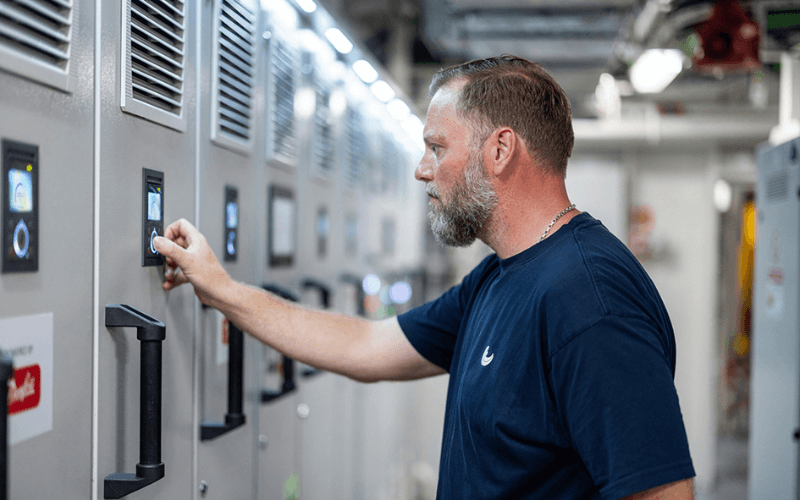
As electrification, cyber resilience, and energy optimization become central to industrial and marine engineering, Danfoss has introduced a significant update to its next-generation drive portfolio with new features for its iC7-Hybrid power converters and iC7-Marine drives. The latest 2026 enhancements are designed to improve functional safety, connectivity, cybersecurity, customization, and compliance, signaling where the future of variable frequency drive (VFD) technology is heading.
The announcement is especially relevant for the HVACR, marine, power conversion, and energy systems sectors, where VFDs are increasingly expected to do more than regulate motor speed. Today’s drive systems must also support grid interaction, operational intelligence, remote diagnostics, digital security, and compact system design all while helping operators meet emissions and performance targets. Danfoss’ latest iC7 upgrades reflect that shift.
A New Benchmark for Advanced Drive Systems
Danfoss says the new and updated features for iC7-Hybrid and iC7-Marine are intended to set a new benchmark in “performance, safety, and connectivity.” While the company has already positioned the iC7 platform as a high-performance solution for demanding electrification applications, the 2026 release moves the portfolio deeper into the era of intelligent, secure, software-driven power conversion.
This matters because VFD technology is rapidly evolving from a traditional motor control component into a core digital infrastructure layer for electrified assets whether that means propulsion systems, hybrid powertrains, energy storage interfaces, compressors, pumps, or distributed power management platforms.
Integrated SIL3 Functional Safety Raises the Standard
Among the most notable updates is the inclusion of built-in SIL3-certified functional safety, specifically Safe Torque Off (STO) and Safe Stop 1 (SS1). These are critical features for applications where personnel protection, equipment safety, and regulatory compliance are non-negotiable.
In practical terms, integrated functional safety can significantly simplify system architecture. By embedding these safety functions directly into the drive platform, Danfoss reduces the need for external safety contactors, relay logic, and additional hardwiring. For OEMs, panel builders, ship integrators, and industrial system designers, that can translate into:
- Reduced cabinet complexity
- Lower component count
- Faster installation and commissioning
- Lower total system cost
- Easier certification and documentation workflows
For the broader HVACR and industrial controls market, this is part of a larger trend: safety is no longer an optional layer it is becoming native to the drive itself.
Cybersecurity Becomes a Core VFD Requirement
Perhaps even more significant is Danfoss’ continued emphasis on cybersecurity-by-design. The new iC7-Hybrid and iC7-Marine updates include strengthened cybersecurity features aimed at meeting the increasingly stringent digital requirements of marine and industrial infrastructure.
That reflects a major shift in how VFDs are being evaluated. In the past, engineers compared drives primarily on efficiency, overload capability, harmonics, or motor control precision. Today, secure communications, access control, firmware integrity, and encrypted data handling are becoming equally important especially in connected systems where drives are integrated into automation networks, remote service environments, and vessel or facility management platforms.
Danfoss highlights hardware-based protection and a crypto-chip-supported architecture across the iC7 family, enabling secure communication and reducing the risk of unauthorized access. For operators of mission-critical systems whether aboard ships, in district cooling plants, industrial refrigeration environments, or hybrid energy installations, this is increasingly a strategic feature rather than a technical bonus.
Native EtherNet/IP Connectivity Simplifies Integration
Connectivity is another major focus of the release, with Danfoss adding native EtherNet/IP support to the iC7-Hybrid and iC7-Marine portfolio. This enhancement allows users to integrate drives into broader automation ecosystems without requiring additional communication hardware.
For system integrators and controls engineers, native fieldbus support is more than a convenience. It can improve:
- Integration speed
- Network standardization
- Spare parts simplification
- Serviceability
- Lifecycle maintenance efficiency
As buildings, ships, and industrial sites become more software-defined, the ability of a VFD to plug directly into digital control architecture is increasingly essential. In HVACR applications especially large chilled water plants, pumping systems, and mission-critical air handling infrastructure this kind of native interoperability can reduce engineering overhead and improve visibility across the system.
Customization Through MyDrive® Insight Adds Engineering Flexibility
Danfoss is also expanding the intelligence layer around the hardware through a new Logic feature in its MyDrive® Insight commissioning tool. According to the company, this function allows users to tailor drive behavior to specific application needs without resorting to fully custom engineering.
That is a notable development because one of the biggest barriers in advanced electrification projects is the trade-off between standardization and customization. End users want flexible systems, but custom code and bespoke control logic often increase cost, risk, and commissioning time.
With configurable logic inside the commissioning environment, Danfoss is effectively pushing VFDs further into the role of application-aware control devices. This could prove especially useful in hybrid energy systems, marine propulsion support functions, power conversion interfaces, and advanced thermal process applications where standard motor control alone is not enough.
Global Marine Compliance Expanded with Class NK Approval
For the marine and offshore segment, Danfoss has also added Class NK marine type approval, expanding the certification footprint of the iC7 platform. This addition strengthens the company’s position in global maritime electrification by enabling broader deployment across vessel classes and geographies.
Marine certification remains a major gatekeeper in shipboard electrification. Drives used in propulsion, thrusters, auxiliary machinery, shore power interfaces, and onboard power systems must meet strict type approval requirements to ensure safety, reliability, and interoperability at sea.
The expanded approvals suggest Danfoss is not just refining product features it is actively preparing the iC7 family for international-scale deployment in future-ready marine electrical architectures.
Why the iC7-Hybrid Matters Beyond Marine
Although the iC7-Hybrid is closely associated with maritime applications, its relevance extends well beyond vessels. The platform is built for power conversion and energy flow management, making it applicable to systems involving:
- Battery energy storage systems (BESS)
- Shore charging infrastructure
- Smart grid interfaces
- Renewable energy integration
- Industrial power conversion
- Microgrid and distributed energy environments
Danfoss positions the iC7-Hybrid as an ultra-compact converter designed to help operators manage energy more efficiently while reducing space and installation burden. The company also notes scalable architecture and fast control response as part of the platform’s value proposition.
This is highly relevant to HVACR-adjacent sectors as well. As more facilities adopt thermal electrification, peak load management, and energy storage-assisted operations, the line between “drive technology” and “energy infrastructure” is becoming increasingly blurred.
Compactness and Power Density Remain Key Advantages
One of the strongest engineering messages across the iC7 range remains high power density. Danfoss states that the iC7-Marine platform can reduce space requirements significantly compared with conventional alternatives, while also lowering cooling loads and simplifying installation layouts.
This compactness is not just about footprint it has major operational implications. In marine engine rooms, plant rooms, skids, packaged energy systems, and electrical cabinets, every saved cubic meter can improve service access, thermal management, and system flexibility.
In HVACR and industrial environments where retrofit constraints are common, compact high-power VFDs can be especially valuable for upgrading existing infrastructure without major structural redesign.
What This Means for the Future of VFD Technology
The Danfoss update points to a clear conclusion: the future of VFD technology will be defined by convergence.
The next generation of VFDs will not succeed based on motor control alone. Instead, they will be judged on how well they combine:
- Functional safety
- Cybersecurity
- Network-native communications
- Software configurability
- Compact hardware design
- Regulatory and certification readiness
- Energy system compatibility
That evolution is already reshaping the role of drives across HVACR, industrial automation, marine electrification, and power conversion markets.
For specifiers, OEMs, contractors, and engineering consultants, the key takeaway is this: the VFD is no longer just a supporting device in the electrical room. It is becoming a strategic intelligent node in the broader energy and control ecosystem.
Industry Outlook
As electrification accelerates across buildings, transport, process industries, and energy infrastructure, the demand for smarter and more secure drive platforms will only intensify. Danfoss’ latest iC7-Hybrid and iC7-Marine enhancements suggest that manufacturers are now designing VFDs not only for efficiency and reliability but for digital resilience, system intelligence, and long-term infrastructure adaptability.
For the HVACR and wider electromechanical industries, that is the real story behind this release: VFD technology is entering a new era where safety, software, and cybersecurity are as important as torque, speed, and power.


